Turn Sketches to Stunning Realistic Art with Fast Image AI
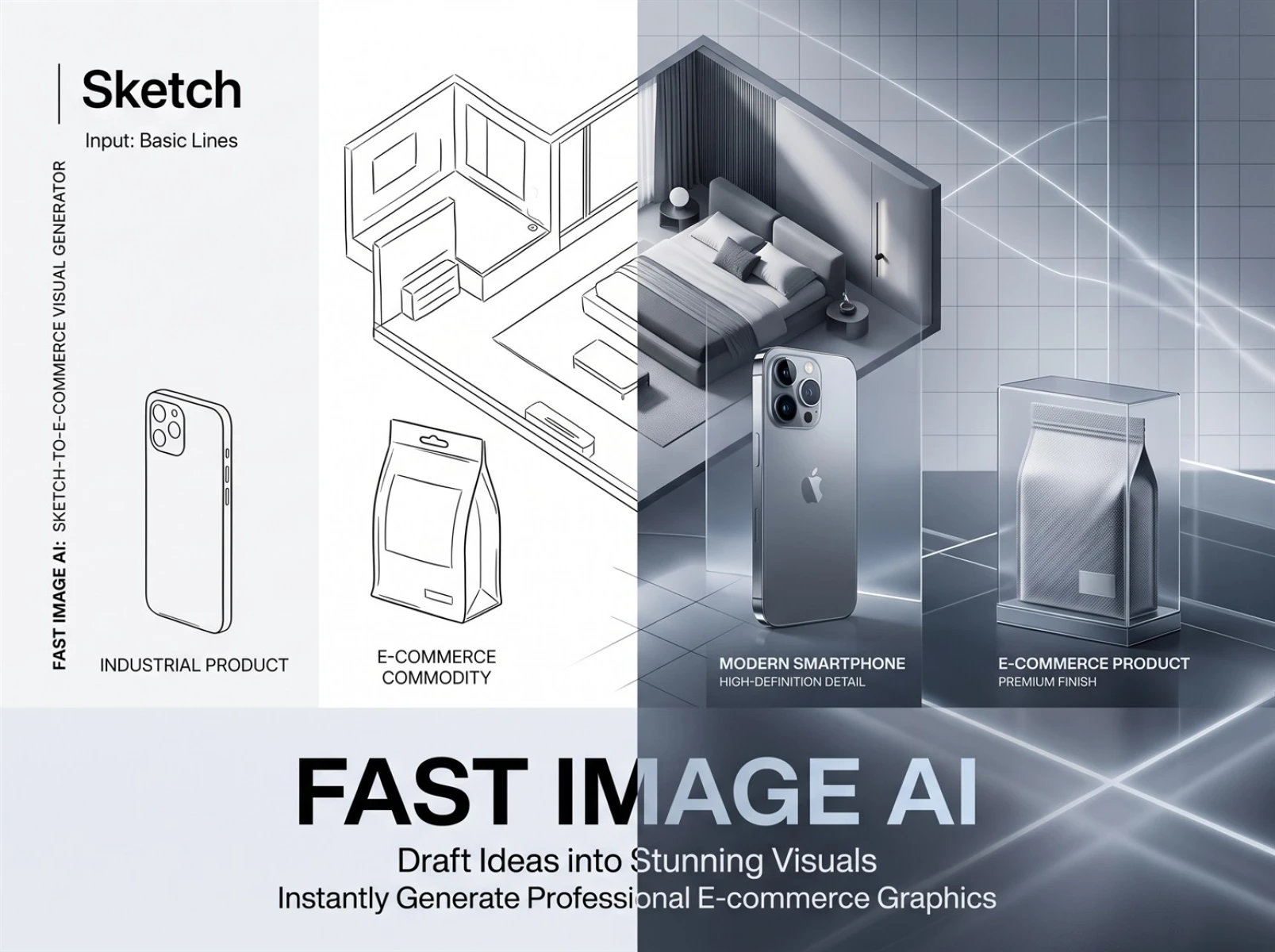
The creative industry faces cumbersome workflows for turning sketches into final deliverables. Hand-drawn drafts are difficult to convert quickly into commercial-grade renderings, with widespread pain points including long production cycles, steep learning curves, and high revision costs. Powered by 3D spatial parsing and global iterative technology, Fast Image AI supports sketch-to-image generation, turning simple line drawings into high-definition photorealistic visuals in seconds. Suitable for creative work across interior design, industrial design and e-commerce, the tool can be mastered in three steps even by beginners. It delivers professional rendering quality and diverse artistic styles, effectively shortening creation cycles and reducing design iteration costs. No complex modeling or detailed hand-drawing is required — simple outlines let you directly visualize ideas in your mind, completing the full creative chain from sketch to finished product.
I. Limitations of Traditional Creation Models Drive Up Overall Visual Production Costs
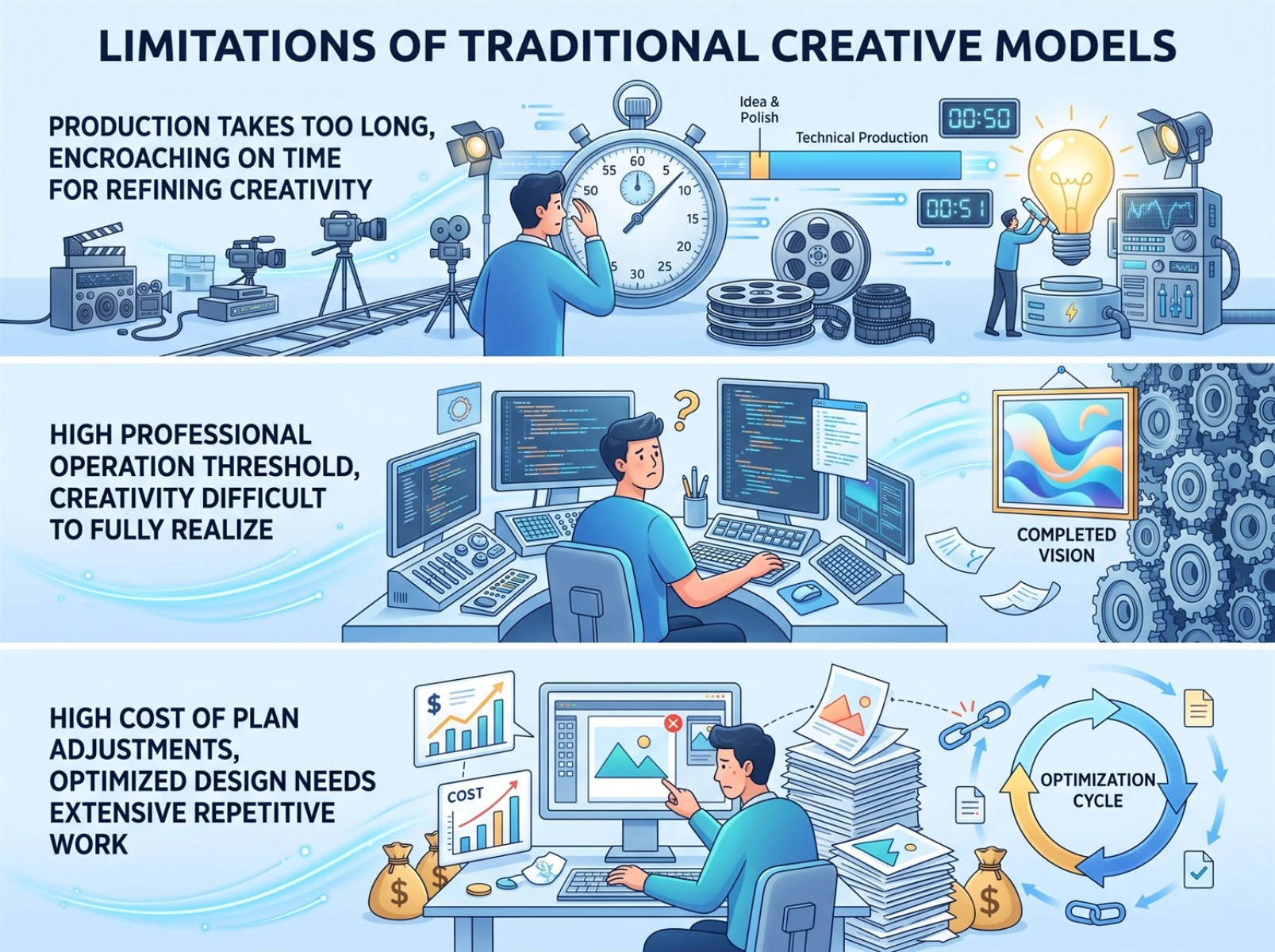
The traditional model of producing commercial renderings from line art has multiple inherent constraints, which tend to disconnect creative ideation from visual execution and lengthen the overall production cycle.
1. Long Production Times Eat Into Creative Refinement
Producing a single commercial-standard rendering requires a complete process including line art refinement, layered coloring, material rendering and lighting adjustment. Even professional designers spend hours on this work, and complex projects can take days. As industry project timelines continue to tighten and frequent revisions become the norm, designers devote large amounts of time to repetitive rendering and minor image adjustments, leaving far less room for ideation and design optimization.
Small design teams and independent creators are even more affected. Slow output limits their iteration efficiency, restricts their ability to take on more projects, and constrains both creative productivity and revenue potential.
2. High Professional Barriers Prevent Full Creative Realization
Anyone can sketch a rough draft, but producing stereoscopic, perspective-accurate finished works requires mastery of perspective principles, material rendering and lighting control, plus proficiency in various professional drawing and modeling software tools. Many practitioners have strong creative ideas but are held back by limited drawing or modeling skills, unable to fully realize their design concepts.
Within enterprises, planning and design roles operate separately, leading to communication gaps. Final visuals often deviate from the original sketch concept, making repeated revisions a routine part of work.
3. High Revision Costs Lead to Extensive Repetitive Work
In interior and industrial design, sketches alone cannot intuitively demonstrate final effects. Physical prototypes and 3D models are required to validate design solutions. Any adjustment to shape, layout or materials incurs additional costs in materials, labor and time.
The same issue exists in digital creation: changing art styles, compositions or product materials requires designers to redraw and re-render from scratch, with every round of optimization incurring substantial costs.
All in all, creators across fields generally face poor connectivity between creative ideas and final visual deliverables. Fast Image AI fills this gap with its sketch-to-image capability, using AI to complete the creative workflow. Rough sketches can be directly converted into full commercial works, effectively easing the creative pressures imposed by time, technical skill and cost constraints.
II. Two Core AI Technologies Enable Accurate Photorealistic Generation from 2D Lines
Fast Image AI is not an ordinary line-art coloring tool. Backed by a deep image generation foundation model and self-developed spatial parsing algorithms, its two core technologies work in tandem to efficiently convert sketches into high-definition commercial renderings, achieving high-quality transformation from simple 2D lines to realistic 3D visuals.
1. 3D Spatial Parsing Technology for Accurate Restoration of Real Object Structure
Most common line-to-image tools on the market only recognize 2D plane outlines. After coloring, the resulting images appear flat, with perspective errors, making them unable to meet the demands of professional scenarios such as interior spaces and industrial modeling.
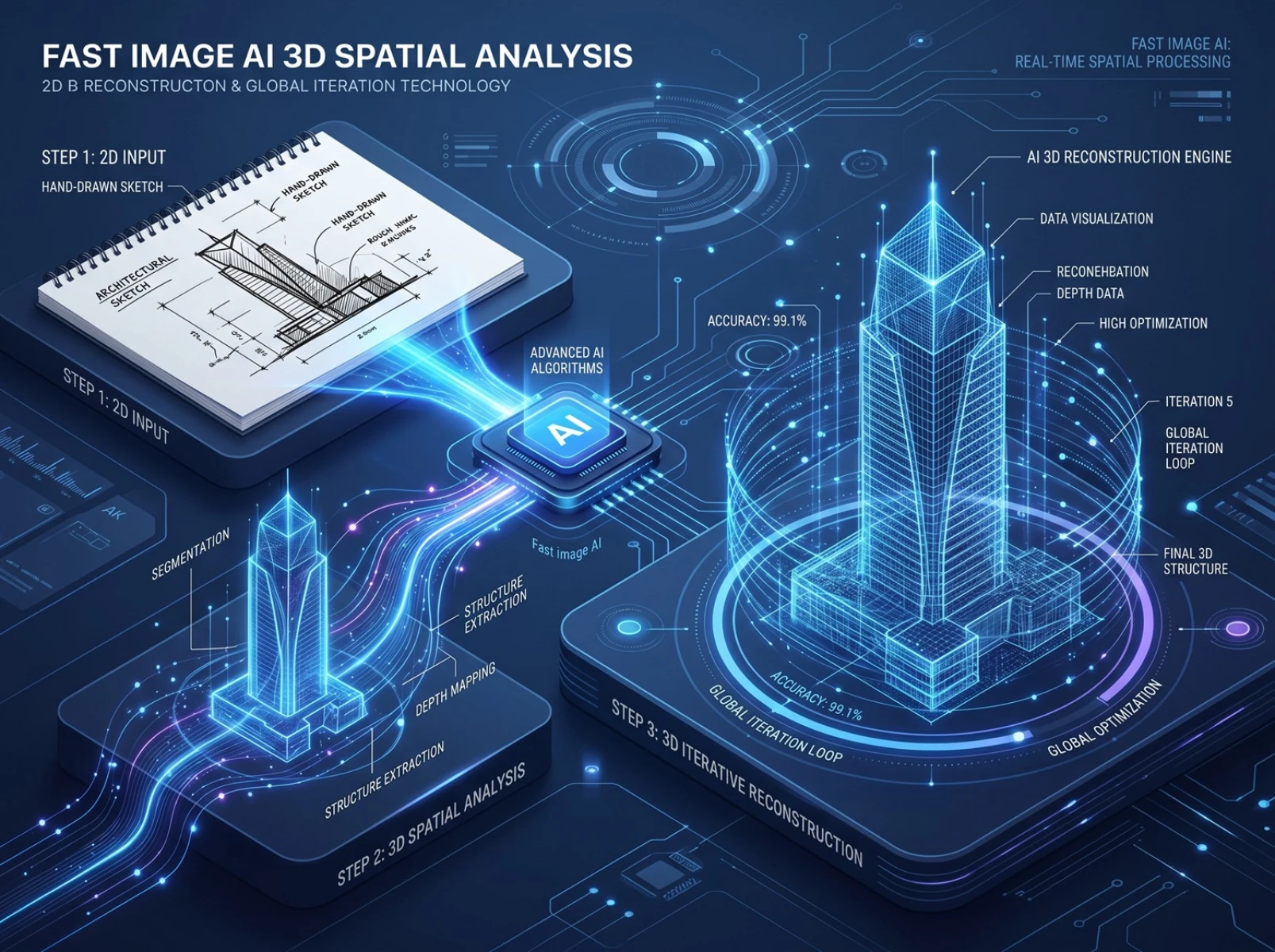
Fast Image AI is equipped with proprietary 3D spatial parsing technology. The moment a sketch is uploaded, the algorithm automatically identifies image perspective, spatial hierarchy, object volume and proportions, reconstructing a complete 3D structure in the underlying architecture before generating the final image.
Even a minimally drawn interior draft can be accurately parsed by the AI to distinguish walls, floors and ceiling boundaries, restore furniture volume and placement logic, and produce realistic scenes that follow physical perspective rules. A few simple product sketch lines can also be translated into realistic 3D textures with accurate curved surfaces and layered edges, delivering sketch-to-image results that align with real-world logic.
2. Global Intelligent Iterative Generation for Low-Cost Detail Refinement
Visual creation requires repeated polishing, and traditional AI image generation tools have clear shortcomings: they can only redraw the entire image by modifying keywords, which is not only inefficient but also prone to object structural errors, style deviations and loss of the original composition.
Fast Image AI’s global intelligent iterative generation technology caters to creators’ needs for fine-grained adjustments, overcoming the flaws of traditional tools. Users can iterate and refine results by fine-tuning sketch lines and adding text prompts based on the initial output.
The algorithm fully preserves the structure, composition and spatial logic of the original sketch, only selectively optimizing details such as materials, lighting, color tone and texture. It supports optimization needs across interior design, industrial design and artistic creation, eliminating the need for full redraws, greatly reducing iteration costs for sketch-to-image workflows, and aligning with the creative rhythm of professional designers.
III. Adoption Across Three Core Industries Reshapes End-to-End Efficient Workflows
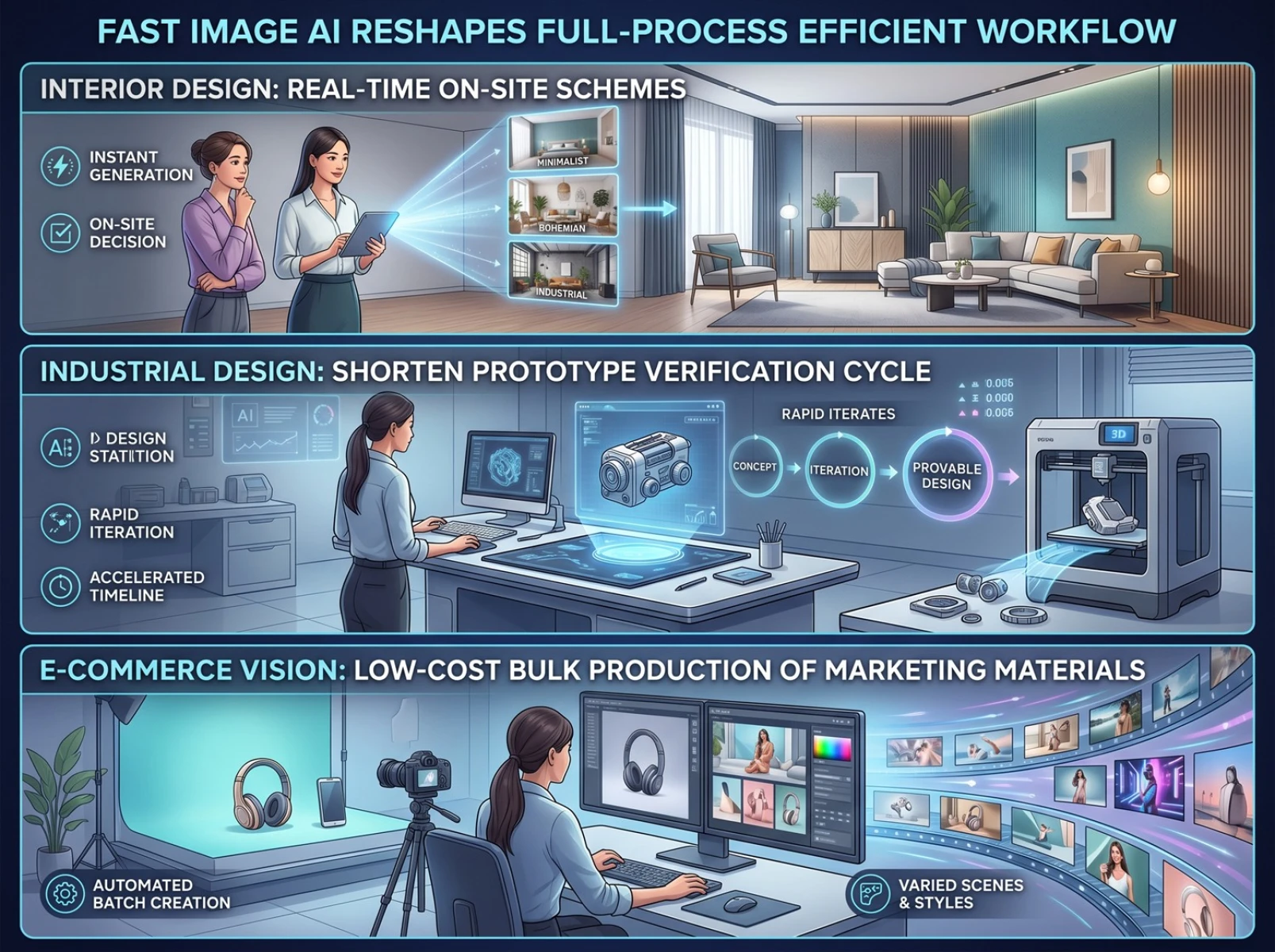
The sketch-to-image feature does more than accelerate drawing speed — it restructures traditional workflows across industries and has been deeply deployed in three major sectors: interior design, industrial design and e-commerce visuals.
1. Interior Design: Real-Time On-Site Proposals to Boost Client Approval
Previously, designers communicated floor plan solutions to clients using static sketches, and most clients struggled to visualize the final result from simple line drawings.
With Fast Image AI, designers can hand-draw layout plans on-site according to client requests and quickly convert sketches into images, generating multiple high-definition realistic renderings with different color schemes, furniture arrangements and soft decoration styles. Three design solutions that once took three days to complete can now be demonstrated on-site during consultations, significantly improving communication efficiency and proposal approval rates.
Designers can also use simple sketches to test renovation ideas in advance, filter out unreasonable layouts early, and focus more on optimizing spatial experience and atmospheric details.
2. Industrial Design: Shorter Prototype Validation Cycles and Lower R&D Investment
Traditional product appearance iteration relies heavily on 3D modeling and rendering; every shape change requires modelers to spend hours adjusting models.
After hand-drawing multi-angle product sketches, designers can use the sketch-to-image feature to quickly generate renderings with realistic materials and natural lighting, intuitively reviewing product proportions, curved surfaces and craftsmanship presentation.
The cycle from creative sketch to review-ready rendering shrinks from days to minutes. Design teams can test multiple creative directions simultaneously, select the optimal solution before proceeding to modeling and prototyping, and reduce upfront R&D investment. This helps businesses in consumer electronics, home goods and cultural and creative sectors accelerate iteration and seize market opportunities.
3. E-Commerce Visuals: Low-Cost Batch Production of Marketing Assets for Cross-Border Operations
E-commerce stores require continuous updates to product scene images. Traditional on-location shooting involves cumbersome workflows, with set building, lighting setup and model hiring all adding extra costs. The long production cycle makes it hard to keep up with the content update pace of platform marketing.
Operators can simply sketch product placement and basic scene outlines, and use the sketch-to-image feature to quickly produce multiple versions of visuals including product main images, detail page scenes and promotional posters, to test the conversion performance of different visual styles.
Cross-border merchants can generate localized visual assets tailored to different countries’ aesthetic preferences with one click, enabling long-term visual operation of overseas stores at low cost.
IV. Three Simple Steps for Zero-Experience Users to Master in Three Minutes
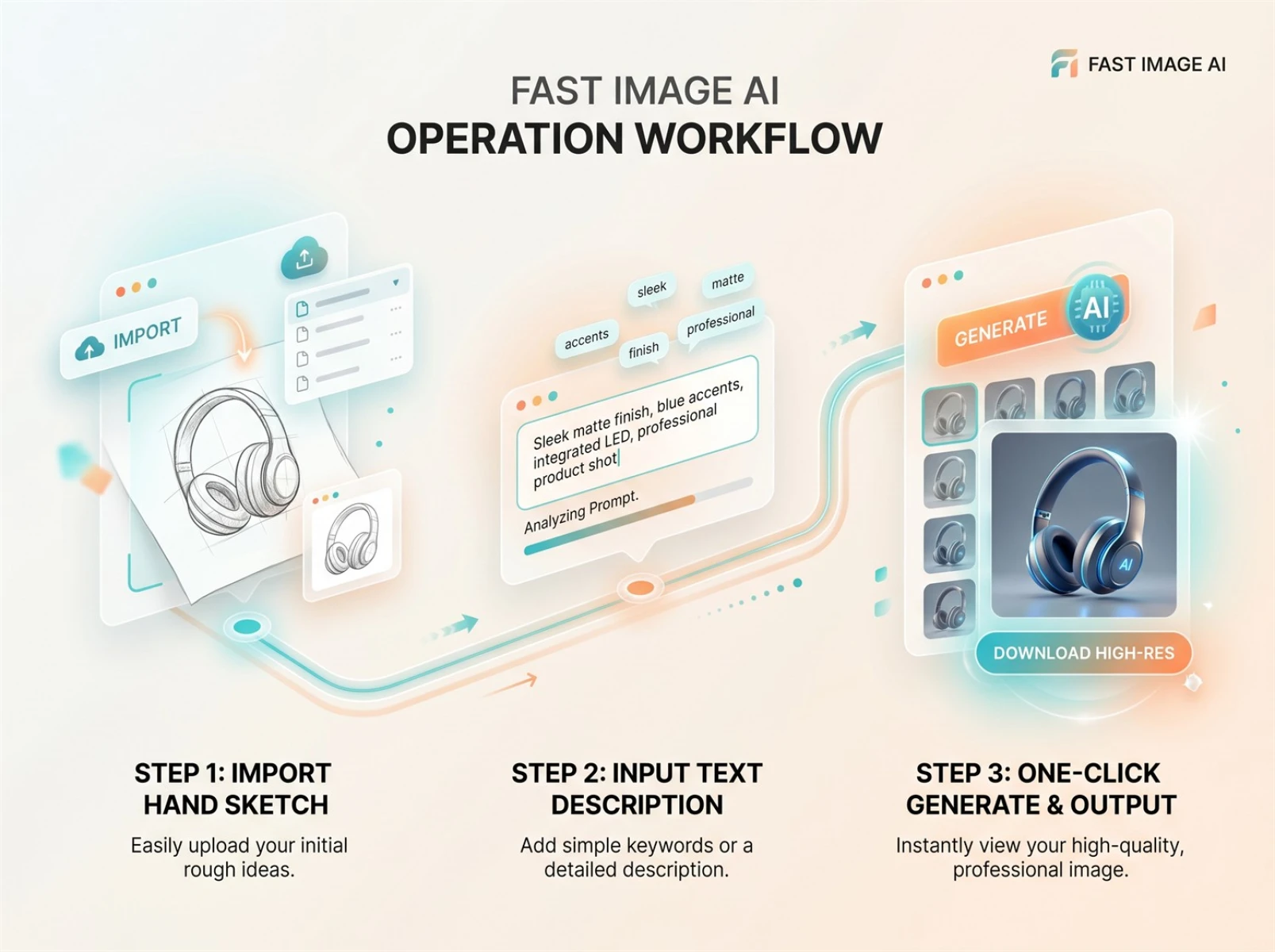
Fast Image AI dispenses with complex, obscure professional parameters, resulting in a low barrier to entry. Even beginners with no AI drawing experience can master the full sketch-to-image workflow in three minutes.
Step 1: Import or hand-draw a sketch. You can upload photos of paper hand-drawings or line art created on a tablet, or draw directly using the platform’s built-in drawing board. Sketches do not need to be neat or detailed; as long as the object structure and general outline are clearly expressed, the algorithm can recognize them accurately.
Step 2: Enter text to supplement visual requirements. Add descriptive prompts alongside the sketch to specify style, materials, color tone and overall atmosphere. The more specific the details, the more closely the final sketch-to-image result will match your expectations. Examples include "modern minimalist cream-style living room, matte soft-gloss floor tiles, warm sunset floor lamp lighting" and "matte black lightweight gaming headset, matte metal texture, dark tech-inspired background".
Step 3: Generate with one click and refine iteratively as needed. Click the generate button to output four high-definition finished renderings in seconds. If unsatisfied with the result, fine-tune sketch lines and modify text prompts to optimize the image via global iteration. To change the overall art style, simply adjust the text description to quickly produce a brand-new solution. The operation logic aligns with creators’ natural thought process.
V. AI Reshapes Creative Logic, Putting Ideas Back at the Core of the Industry
Today, the core competitiveness of the visual industry lies in creativity, iteration speed and restoration accuracy. With Fast Image AI’s sketch-to-image capability, simple sketches can be directly turned into commercial finished products.
If you have long struggled with slow output, high revision costs or difficulty realizing creative ideas, try this tool. Use sketch-to-image generation to quickly produce complete high-quality visual works, and focus more of your energy on creativity itself.