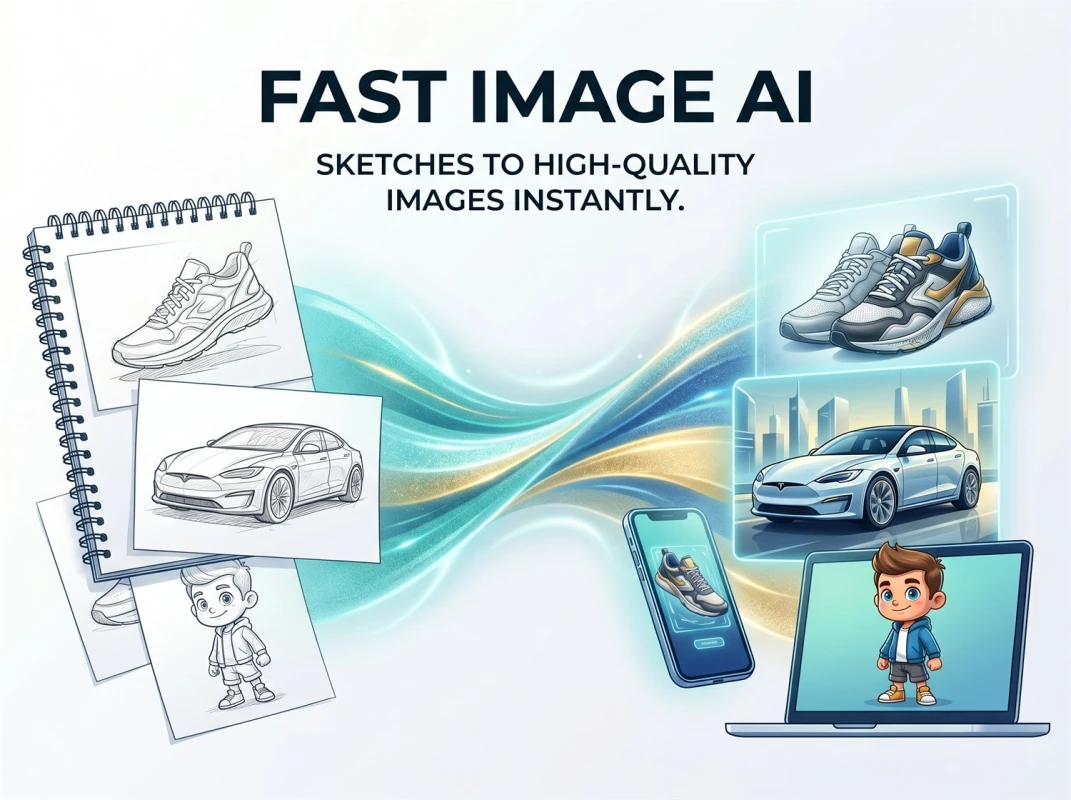
Hand-drawn sketches to commercial-grade renderings - Fast Image AI drastically cuts down design
"The client needs the proposal tomorrow!"
This line has long been a work nightmare for countless designers. When you quickly sketch creative ideas in your sketchbook, full of anticipation that your plan will impress the client, the real workload has only just begun. In the traditional workflow, designers must open 3D software such as 3ds Max, SketchUp and C4D, build models point by point from hand-drawn lines, adjust materials, arrange lighting, tweak rendering parameters, and then wait hours for the render to complete. After finally producing the first version of the rendering, if the client requests changes such as "improving the image texture", the entire process must be repeated, consuming enormous amounts of time.
Currently, the penetration rate of AI tools in the global design industry has reached 85.8%. However, the vast majority of AI drawing tools on the market only support text-to-image generation and cannot accurately restore the spatial structure and original creativity of hand-drawn sketches, resulting in extremely low sketch-to-final efficiency. Fast Image AI has specifically addressed this common industry pain point: it accurately identifies hand-drawn lines, fully preserves design details, and produces high-definition renderings ready for direct commercial use in just a few minutes, reducing overall design time by up to 80%.
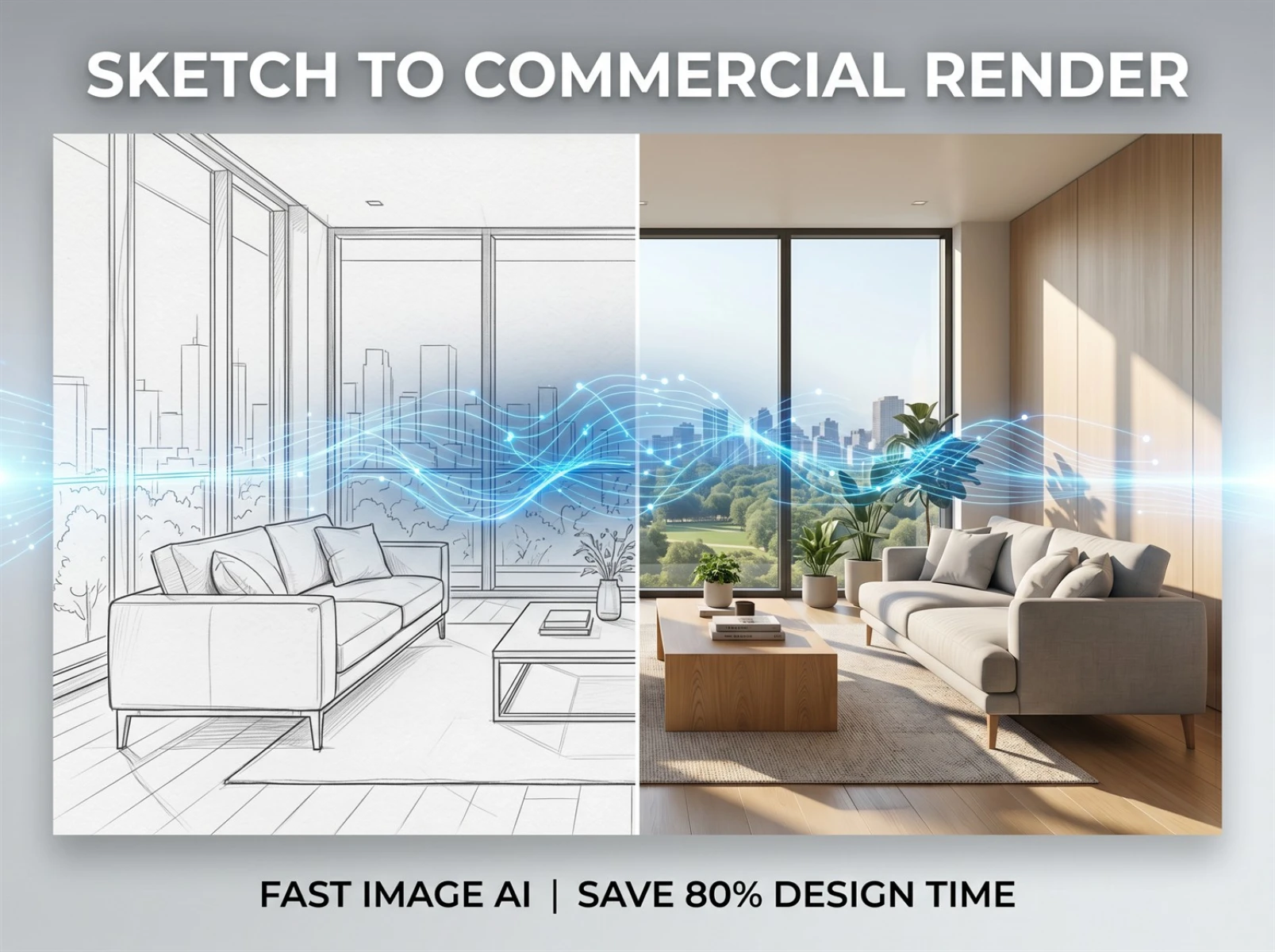
I. Traditional Design Workflow: 80% of Working Hours Spent on Repetitive Basic Tasks Such as Modeling and Rendering
Taking a medium-complexity interior design project as an example, we outline the complete traditional process from hand-drawn sketches to commercial renderings:
The first stage is hand-drawn communication and finalization: designers collaborate with clients to repeatedly confirm spatial layout, overall style and soft furnishing configurations. This step typically takes 3 days.
The second stage is 3D digital modeling: converting hand-drawn lines into standard 3D models. Walls, furniture and soft furnishings must be built manually, taking 4 to 7 days.
The third stage is material and lighting adjustment and rendering: this is the most time-consuming and technically demanding part of the entire process. Even minor changes to material parameters require re-rendering.
Rendering a 4K-resolution interior rendering on conventional high-performance hardware takes 1 to 3 hours. If the client requests detailed modifications such as changing soft furnishing colors or adjusting lighting angles, you must wait another several hours for re-rendering. For large-scale commercial projects requiring multi-perspective renderings, manual modeling and rendering can almost never meet tight deadlines.
Industrial design and e-commerce visual design are also plagued by efficiency bottlenecks. Product designers must switch between multiple software programs including Rhino, C4D and Keyshot; simply adjusting a product's metal texture and shadows can take an entire workday. Cross-border e-commerce designers face intense demand during peak promotion periods. During events such as Black Friday and Cyber Monday, operations teams issue multiple visual requests per day, and a single product hero image often requires more than ten iterations. Delayed production directly impacts product launch schedules.
According to global design industry survey data, designers spend 60%–80% of their daily working hours on mechanical, repetitive tasks such as modeling, rendering and repeated revisions, leaving less than 20% of their time for creative ideation, client communication and scheme optimization. Many designers joke that they have become "software operators".
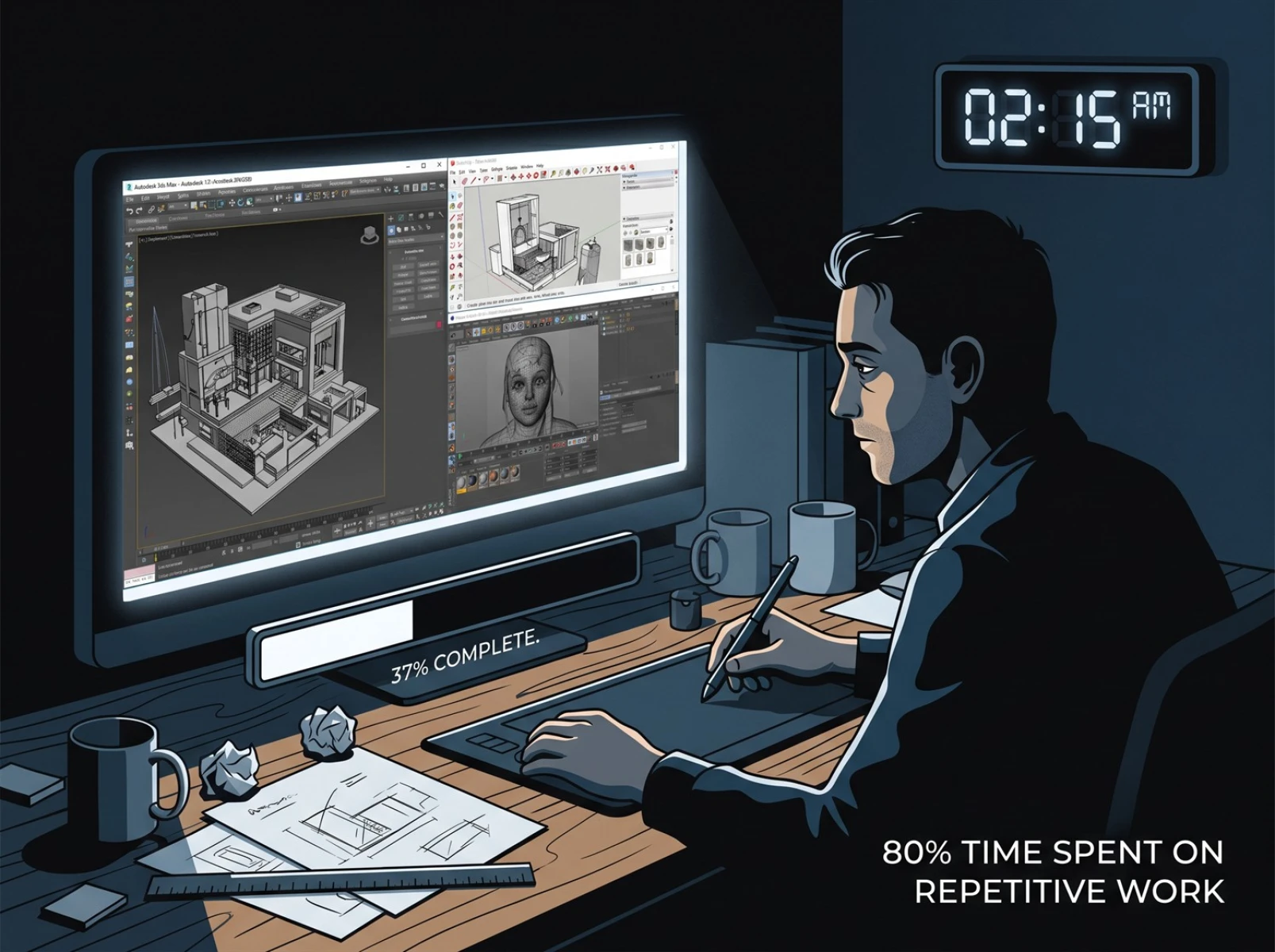
II. Fast Image AI: One-click Realization of Hand-drawn Ideas, One-stop Conversion from Sketches to Commercial Renderings
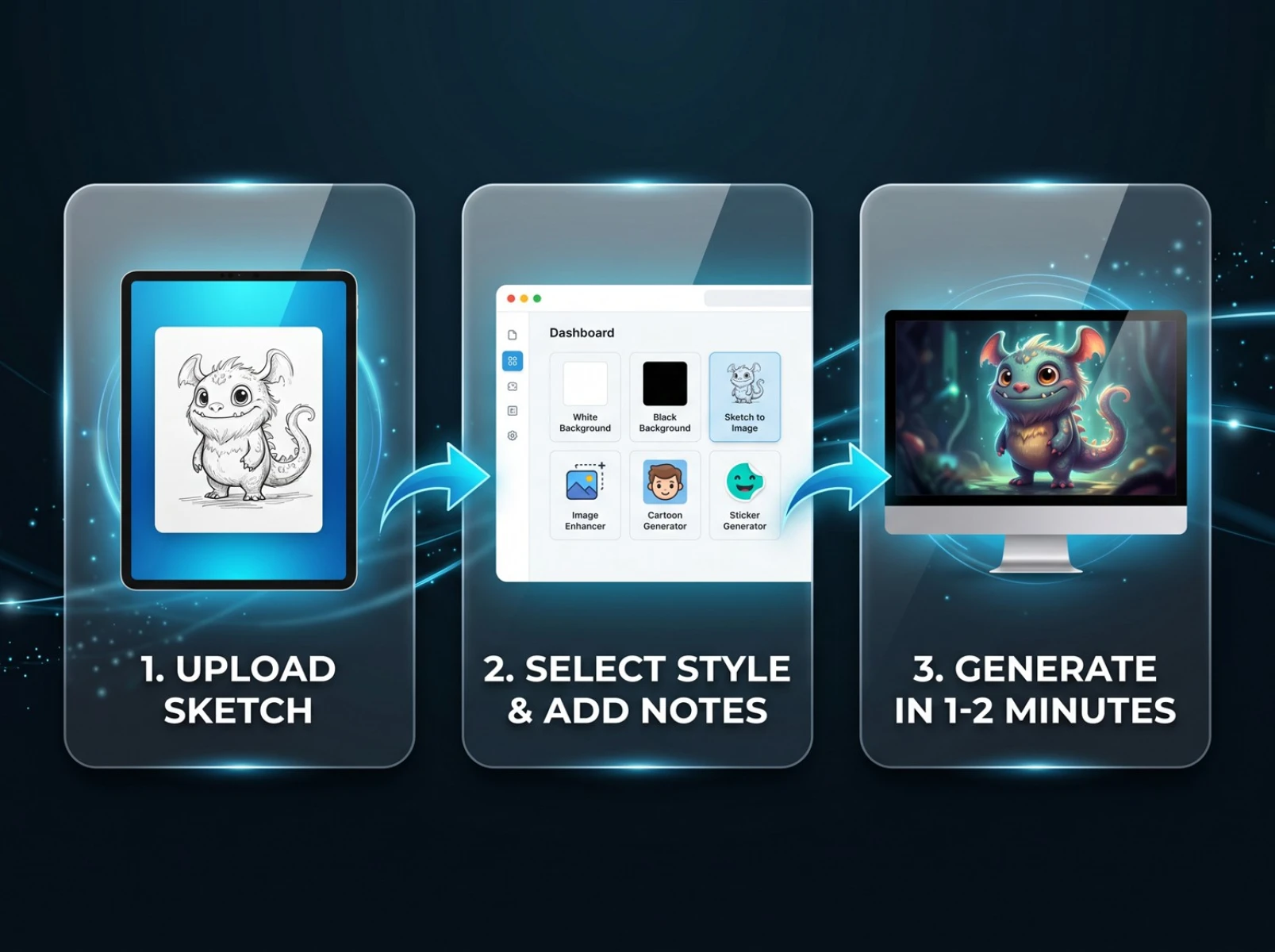
The core advantage of Fast Image AI is its end-to-end rapid conversion from hand-drawn sketches to commercial renderings. Designers do not need to master various 3D modeling software, nor do they need to write long, complex prompts. In just three steps, hand-drawn creativity is transformed into high-definition drawings that meet commercial standards:
1. Upload the original hand-drawn manuscript
Whether it is a paper sketch or a detailed line drawing created with a graphics tablet, the tool can accurately identify it. Using edge detection and spatial structure analysis algorithms, it fully captures the lines and outlines of the image, preserving the original design intent to the maximum extent. Unlike generic AI tools, it will not ignore the sketch structure or generate images unrelated to the original, preventing design distortion at the source.
2. Select a style template and add simple descriptive words
The software comes with hundreds of built-in mainstream commercial design style templates: interior design covers modern minimalist, Nordic, wabi-sabi, industrial and new Chinese styles; product and e-commerce design includes realistic, tech-minimalist, guochao (Chinese national trend), e-commerce white-background and other types. After selecting the "sketch to image" style, users only need to briefly specify materials, colors and scene atmosphere (for example, "light gray fabric sofa, wooden coffee table, afternoon natural light") to customize the visual effect.
3. One-click generation of high-definition renderings
After clicking the generate button, 4K high-definition renderings are output in 1–2 minutes, with support for customizing the number of images. The finished products feature natural lighting and rich multi-perspective effects. The generated drawings can be directly downloaded for client presentations, or parameters can be fine-tuned to iterate multiple versions of the scheme to meet diverse design requirements.
Work that used to take days or even weeks in the traditional mode can now be completed in a fraction of the time, delivering a leapfrog improvement in rendering production efficiency. Moreover, the finished image quality fully meets commercial standards, with realistic material reproduction, natural lighting layers and complete details. They can be used directly for client presentations, project bidding, and product display on cross-border e-commerce platforms such as Amazon and Shopify.
III. More Than Just Speed: Comprehensively Solving Core Pain Points in Commercial Design Implementation
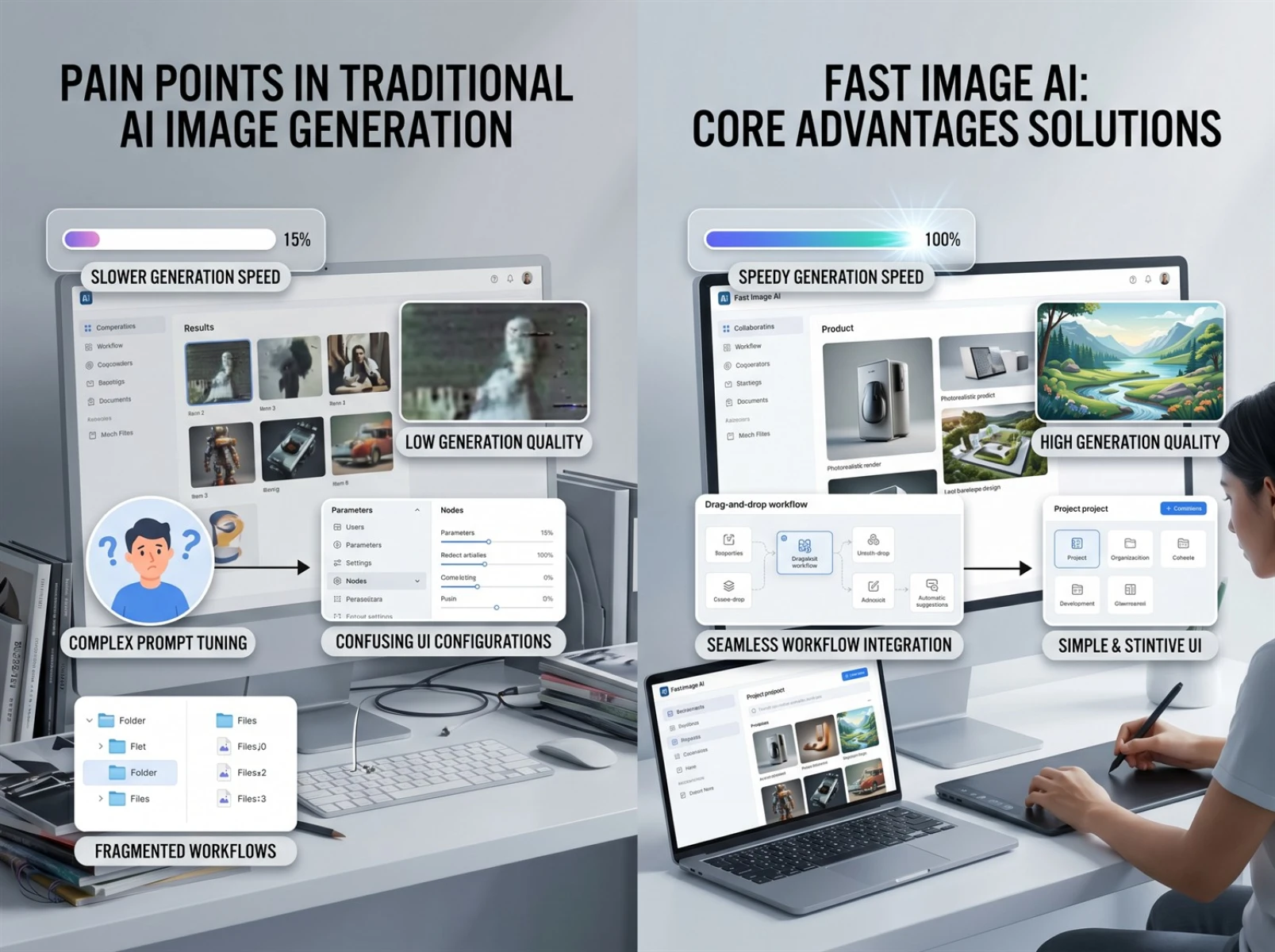
Many designers have concerns about AI drawing: fast output but rough image quality that fails to meet commercial project standards, as well as common issues like image distortion and style inconsistency after sketch conversion. Fast Image AI was positioned as a professional commercial AI design tool from its inception, and has undergone multiple algorithm optimizations targeting core industry needs:
1. Accurate and Consistent Style Restoration
The model is trained on over 10 million global commercial renderings, giving it a far deeper understanding of various industries and design styles than generic AI drawing tools. Selecting the "e-commerce white-background" template automatically generates product hero images with clean compositions, no unnecessary clutter, and compliance with global e-commerce platform specifications. Selecting the "sketch to image" template produces renderings with accurate perspective, realistic materials and uniform texture, ensuring professional visual quality throughout the project.
2. Flexible Iteration: No Need to Redo Entire Work for Revisions
Traditional AI tools produce uncontrollable results; if the image does not meet expectations, it must be completely redrawn, and repeated iterations waste significant time. Fast Image AI has optimized its parameter control logic: if rendering details do not meet requirements, you can separately adjust keywords for style, materials, lighting, scene and other elements to directionally optimize specific parts of the image without regenerating the entire thing. This greatly shortens the scheme modification cycle and allows designers to precisely control the final result.
3. Strong Spatial Consistency Across Multi-perspective Images
When most generic AI tools generate multi-perspective renderings of the same scene, they often produce inconsistencies in the position and material of soft furnishings and decorative items, leading to severe visual discontinuity. This tool features exclusive 3D spatial analysis technology. When generating multi-perspective renderings, the position, size and material of all objects remain consistent, making it ideal for commercial projects requiring panoramic display and multi-angle scheme comparison.
4. Lowering the Technical Barrier to Design
In the past, producing high-quality commercial renderings required proficiency in multiple professional 3D software programs and extensive practical rendering experience, making it difficult for entry-level practitioners to complete the entire drawing process independently. Now, even industry newcomers and entrepreneurs without professional design backgrounds can produce professional renderings using Fast Image AI as long as they can draw simple sketches. Creativity is no longer limited by software operation skills.
IV. Real-world Implementation Cases: Efficiency Upgrades Directly Drive Business Growth
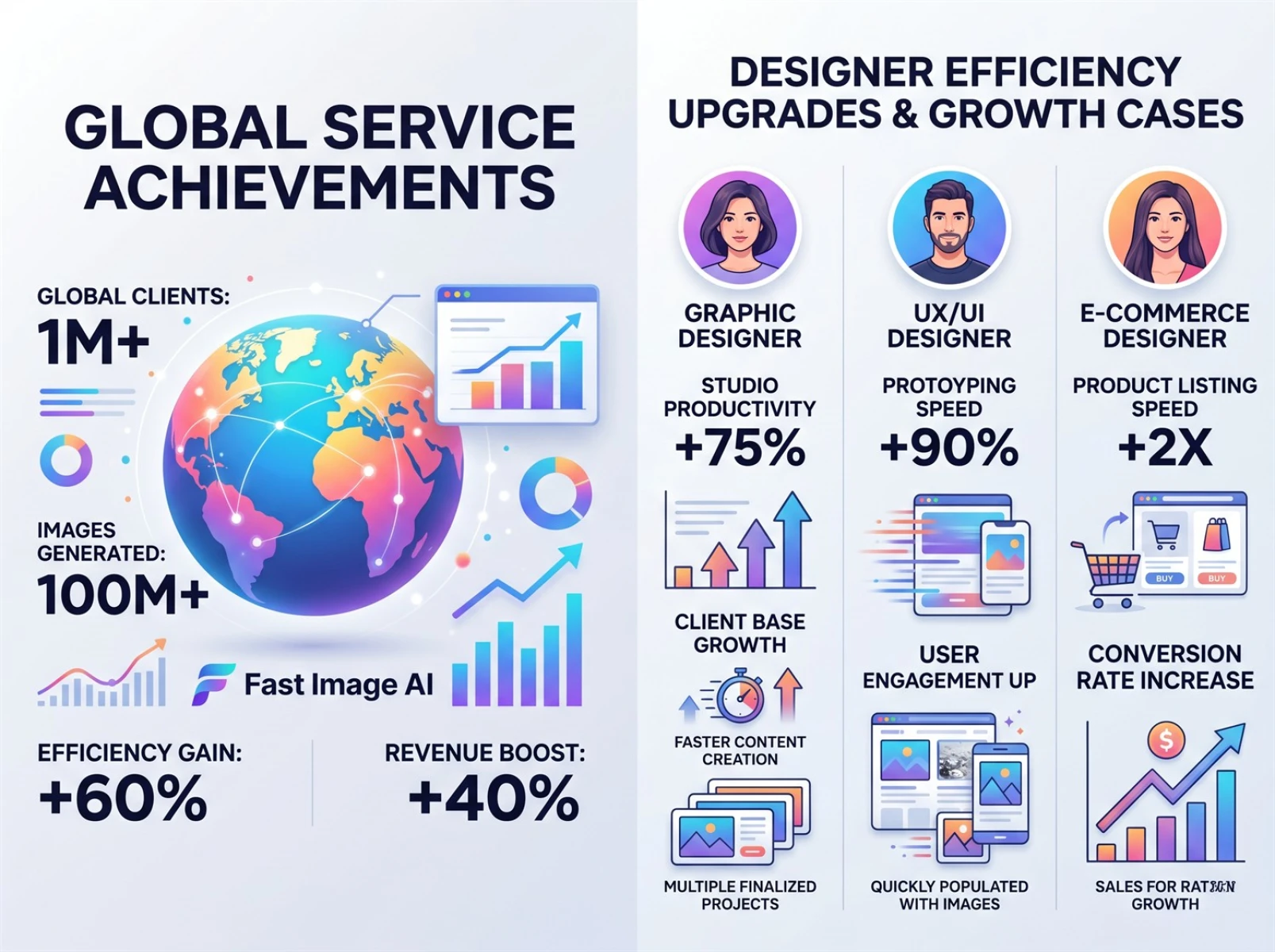
Six months after launch, Fast Image AI has served more than 500,000 designers in over 120 countries and regions worldwide. Its efficient sketch-to-rendering capability has completely reshaped the industry's working model, and many practitioners have achieved significant business growth:
1. Interior Designer Ms. Li
Before using the tool, rendering production was time-consuming, and she could only take on 2–3 projects per month; the complete production cycle for a three-bedroom apartment rendering was 3 days. After adopting Fast Image AI, the entire rendering production process is compressed to half a day, the number of monthly projects she can handle has increased to 6–8, and her personal income has doubled. She can now adjust and output renderings immediately when clients request changes on-site, significantly improving project conversion rates.
2. Cross-border E-commerce Visual Designer Mr. Wang
Mr. Wang is responsible for the full visual design of three overseas stores. In previous years, he had to work overnight during major promotions and still struggled to deliver materials on time. Now, the production time for a single product hero image has been reduced from 4 hours to 5 minutes. Without the need for offline shooting or post-production retouching, he only needs to upload hand-drawn sketches and add simple requirements to produce multiple versions of hero images. During last year's Black Friday promotion, he independently completed all promotional visual materials for all three stores.
3. Consumer Electronics Industrial Designer Mr. Zhang
In the traditional process, it took 5 days from hand-drawn concept sketches to commercial renderings. The cumbersome modeling and rendering process forced many creative ideas to be abandoned due to long production cycles. After using Fast Image AI, the entire process is shortened to 1 day. All kinds of creative ideas can be quickly converted into visual renderings, allowing him to provide clients with multiple alternative schemes and significantly increasing project win rates.
V. Conclusion: AI Does Not Replace Designers – It Unleashes Creative Productivity
There is a widespread concern in the industry that "AI will replace designers", but real-world application tells a different story: AI tools are liberating designers from repetitive labor such as modeling, rendering and repeated revisions. With Fast Image AI's efficient sketch-to-rendering capability, designers can eliminate 80% of mechanical work, focus their energy on high-value tasks such as creative planning, client communication and scheme optimization, escape the pressure of urgent deadlines, and have more time to improve their professional skills and expand business channels.
Fast Image AI is not positioned to replace designers' creativity, but to be their efficient assistant. It takes over the time-consuming and labor-intensive work of modeling and rendering, allowing designers to return to the essence of design. The core of design is to solve problems and create unique value. In the new era of AI-empowered design, designers who master AI tools and efficient sketch implementation processes will have stronger global market competitiveness – and Fast Image AI is the core tool for designers to embrace this industry transformation.