The Creative Link - Sketch to Commercial Images via Fast Image AI
What is the best sketch-to-image tool?
Every creative professional has asked this question. At your desk at 2 a.m., crumpled drafts pile up across half the table, and the 7th version of the line art is still rejected. The image in your mind is clear and complete, but when you put it to paper, it amounts to nothing but crooked lines and rough outlines. You may have tried many hand-drawn sketch-to-image tools — some only recognize polished final drafts and fail to interpret messy sketches correctly; others produce images with fragmented details and chaotic spatial logic, making them suitable only for reference, not commercial use.
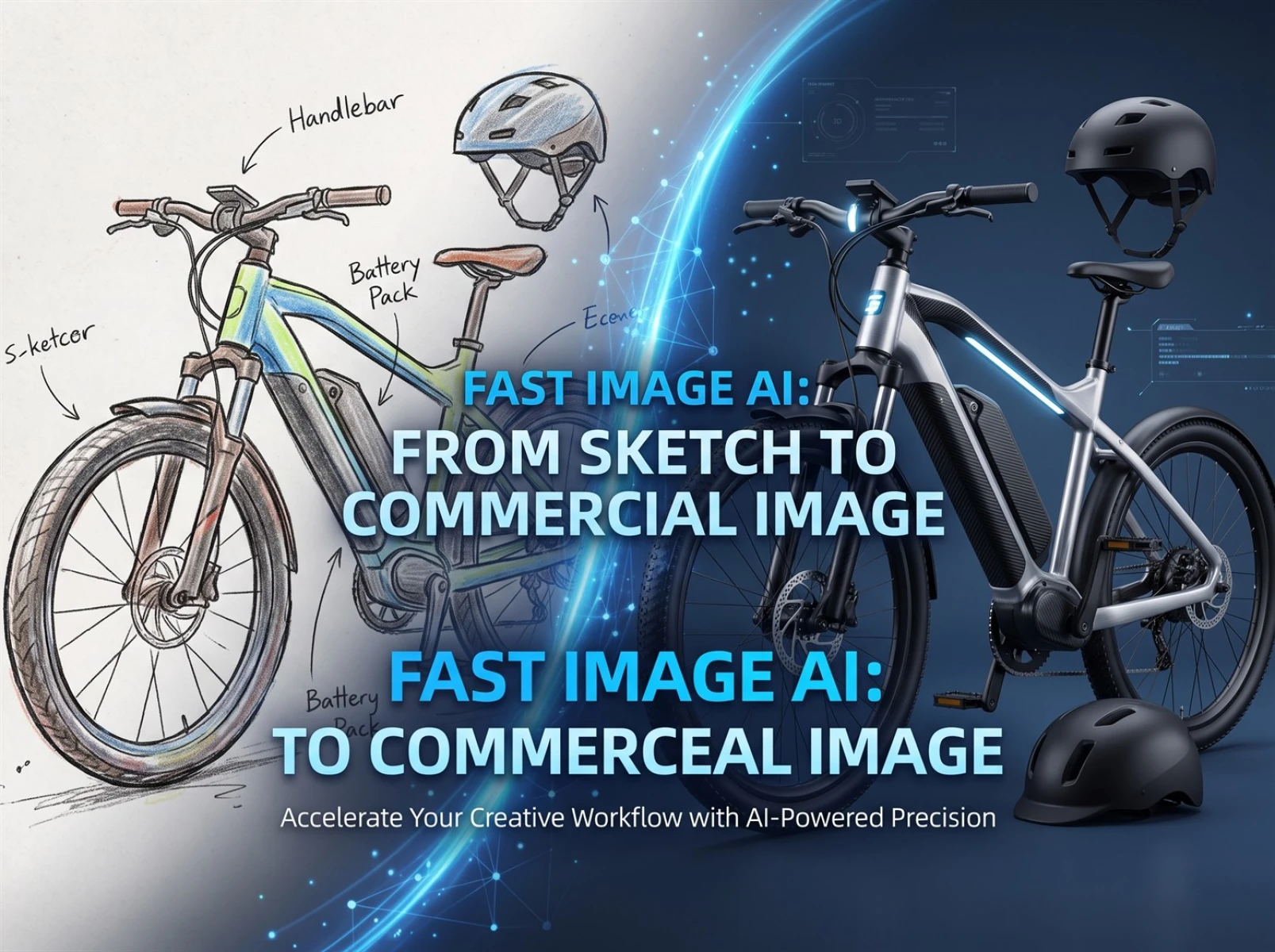
Turning rough sketches into deliverable commercial images used to mean consecutive all-nighters, dozens of revision rounds, clients lost to long wait times, and the frustration of watching great ideas fade before they can be realized. Now, Fast Image AI’s sketch-to-image feature compresses this days-long workflow into mere seconds.
I. The Core Bottleneck of Creative Execution: Why Sketch-to-Image Remains an Efficiency Dead End
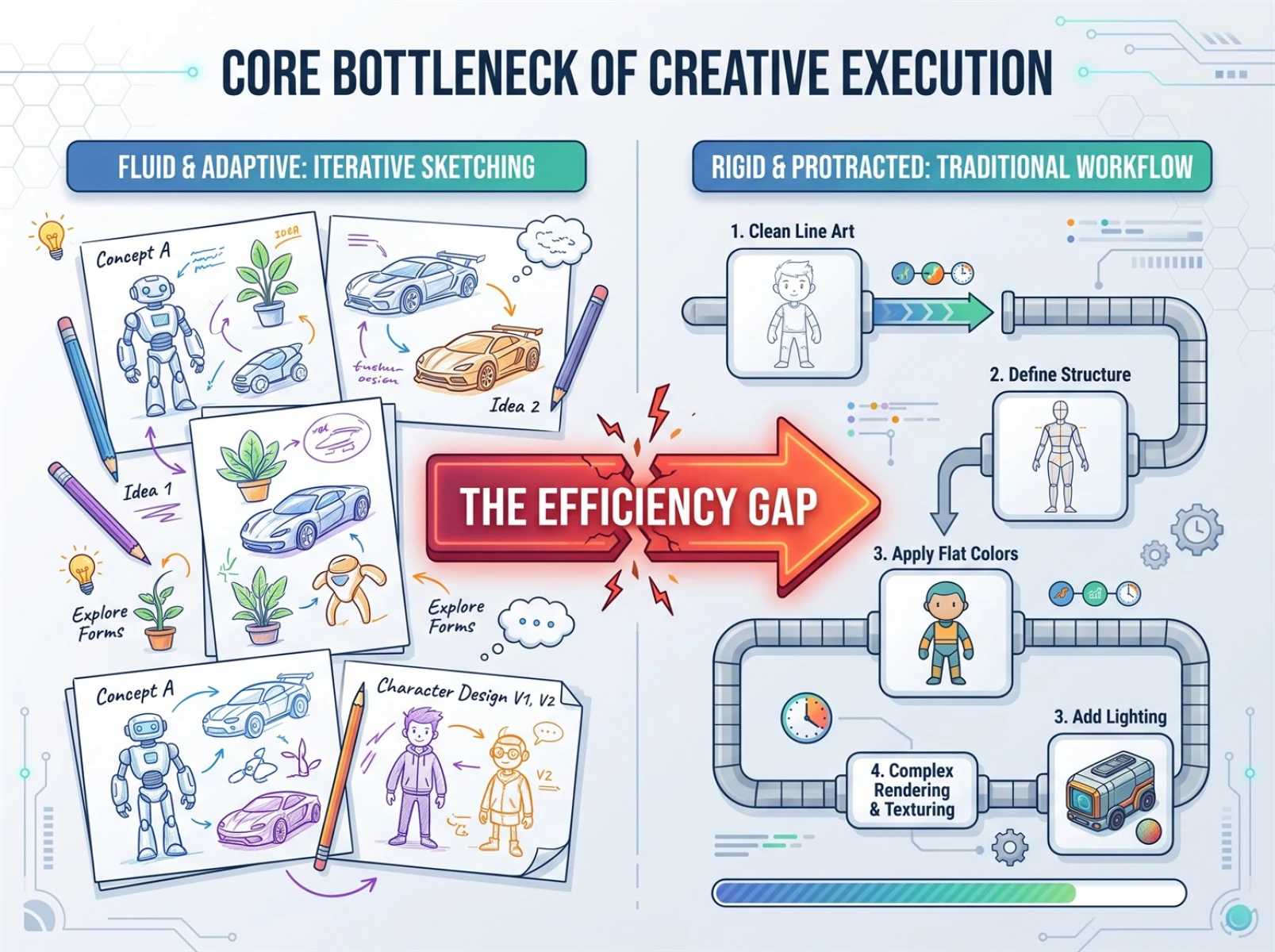
Every creator knows this frustrating disconnect: the sketch stage is where inspiration flows most freely. With a pen and paper, you can draft multiple concepts in minutes — perspective does not need to be precise, lines do not need to be straight, as long as the idea comes through. But once you enter the sketch-to-image execution phase, all that freedom vanishes instantly. Refining line art, structuring layouts, adding color and lighting, and adjusting materials — for a moderately complex rendering, even a seasoned designer needs 3 to 5 working days. For 3D modeling and rendering, the cycle stretches to one or two weeks.
What is even more draining is endless revisions. A client’s casual remark that “it just doesn’t feel right” can mean scrapping most of your work and starting over. It is not that you lack creativity — it is that you cannot afford the time for repeated execution. It is not that you cannot produce high-quality work — it is that you cannot keep up with ever-shrinking project deadlines. The traditional line-art-to-final-image workflow essentially traps creatives in repetitive technical labor, leaving precious little time for actual creative thinking.
The barrier is even higher for spatial creation: for interior design, game scenes, and architectural concepts, a single line with distorted perspective can ruin the entire visual effect. Creators need to master not just drawing skills, but also knowledge of space, materials, and lighting — many ideas get stuck at the technical threshold before they can be realized. Ordinary AI sketch-to-image tools mostly just “copy what they see”: they replicate crooked lines and faulty perspective as-is, without actually solving the underlying problem. On the one hand, client demands are accelerating and the number of proposals is growing; on the other hand, human capacity has a ceiling and training new talent takes time. The entire creative industry is stuck at the same bottleneck: the efficiency gap between rough drafts and commercial images devours the vast majority of creative potential.
II. Fast Image AI’s Sketch-to-Image Feature: Turn Messy Hand-Drawn Sketches into Commercial-Grade Images in One Click
Fast Image AI’s sketch-to-image feature was never designed to be a simple “line art colorization tool” — it was built to fully connect the entire pipeline from draft to commercial output. It does not require perfect line art or complex parameter tuning. Even a quick, messy doodle can be turned directly into a professional, deliverable final image.
1. 3D Spatial Parsing: It Understands Creative Intent — Sketch-to-Image Is More Than Mechanical Tracing
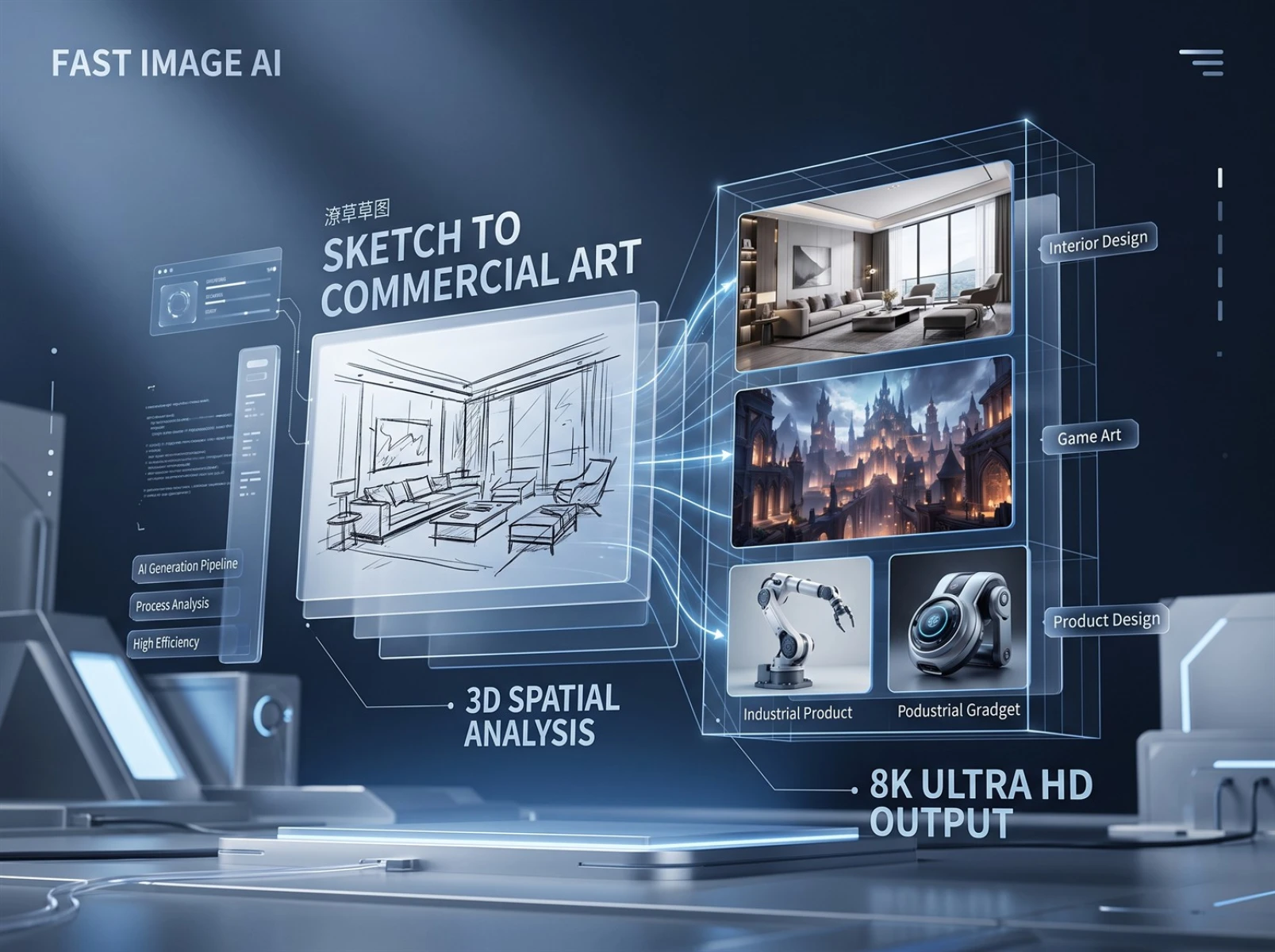
Ordinary AI line-art-to-image tools mostly operate on the superficial logic of “filling styles along the lines”, preserving crooked lines and faulty perspective as-is, and easily producing final images with broken spatial logic. Fast Image AI is equipped with a self-developed 3D spatial parsing engine that can reconstruct 3D spatial structures from distorted 2D lines, accurately identifying walls, floors, perspective relationships, and object proportions. Even with sketchy lines and rough outlines, it can precisely capture the creator’s spatial layout intent instead of mechanically replicating the lines. You no longer need to polish rough drafts into refined line art — draw wherever your ideas take you, and the AI will reliably bring your vision to life.
2. Full Style Coverage: Precisely Matches Diverse Commercial Scenarios — One Sketch, Multiple Solutions
The worst scenario in creative execution is having only one option. Presenting a single solution cedes the initiative; having multiple style alternatives puts you in control. This sketch-to-image AI covers a full range of commercial style models: modern minimalist and new Chinese styles for interior design; cyberpunk and fantasy epic styles for game concept art; metal and glass textures for industrial design, plus dozens of targeted styles for illustration, animation, architectural exteriors, and more. With the same sketch, you can switch models and add text descriptions to generate different visual solutions in dozens of seconds. Finalize requirements in the morning, and present three style comparisons in the afternoon — drastically improving proposal efficiency.
3. 8K High-Resolution Output: Generated Results Meet Commercial Delivery Standards Directly
Many AI-generated images look stunning from afar but fall apart up close — details break down when zoomed in, making them only good for reference, not direct commercial use. Fast Image AI’s sketch-to-image feature supports output at up to 8K resolution, with realistic material textures, natural light and shadow transitions, and details that hold up to close inspection. The AI also automatically corrects perspective deviations and proportion flaws in the original sketch, producing final images with rigorous, self-consistent visual logic. No post-production retouching or detail work is needed — generated images can be used directly for project reports, client proposals, and e-commerce displays. The full process from sketch to high-resolution final image takes just dozens of seconds.
III. Real-World Testing in Three Core Scenarios: Tangible Productivity Gains from the Sketch-to-Image Feature
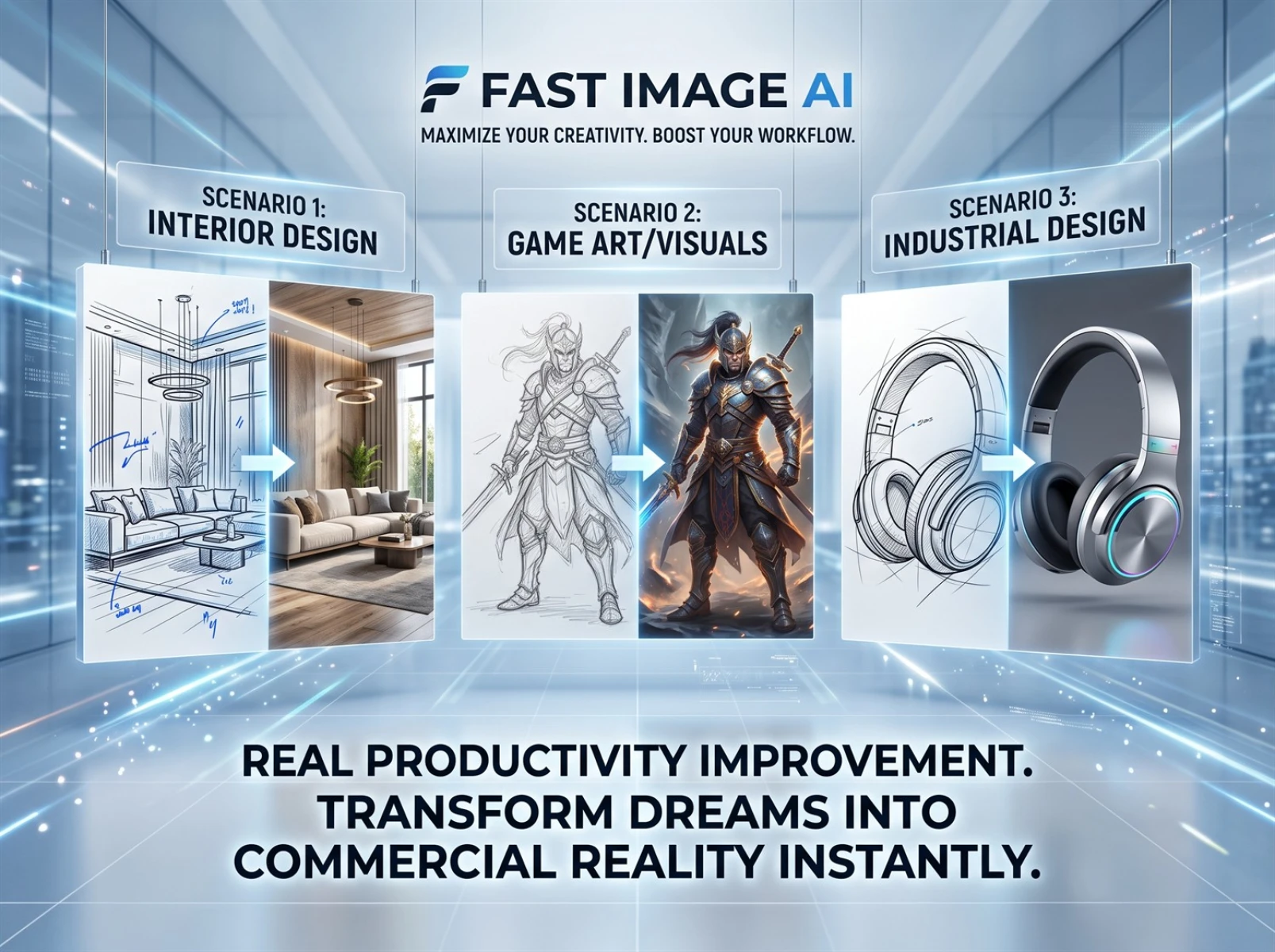
A tool’s value is ultimately proven in real work. Tens of thousands of designers and creators already use Fast Image AI’s sketch-to-image feature to restructure their workflows, with the most significant efficiency gains seen in three core scenarios.
1. Interior Design: Turn Hand-Drawn Sketches into Renderings On-Site, Directly Boosting Signing Rates
In the traditional interior design process, measuring the space, drawing CAD files, and producing 3D renderings take at least three or four days — and many clients are poached by competitors while waiting for the renderings. With Fast Image AI’s sketch-to-image feature, rough sketches drawn on-site during a space measurement can be turned into multiple style renderings instantly. Clients can switch between natural wood style, light luxury style and more with one click, without having to “imagine the effect”. Directions can be finalized on the spot, communication costs are greatly reduced, and signing conversion rates improve significantly.
2. Game Concept Art: Turn Concept Sketches into Final Images Rapidly, Multiplying Art Output
Game development is always racing against version deadlines. Iterating a scene or character from sketch to final version takes more than a dozen rounds, and understaffed concept art teams are a common industry bottleneck. With the sketch-to-image tool, the lead artist draws a rough composition sketch, enters style keywords, and generates over a dozen concept versions in minutes. The team first filters directions and finalizes the style, then hands the selected concepts over to artists for detailed refinement. Where teams used to produce only 2–3 concept versions a day, they can now explore over a dozen creative directions daily — multiplying art productivity several times over.
3. Industrial Design: Turn Line Art into Commercial Renderings, Cutting High Prototyping Costs
A single physical prototype for an industrial product can cost thousands of yuan and take one to two weeks. Many designs only reveal proportion or texture issues after prototyping, resulting in massive wasted costs. With Fast Image AI’s sketch-to-image feature, you can generate realistic material renderings right after drawing product line art, switching between metal, plastic, glass and other materials with one click. Converting line art to commercial renderings lets you verify visual effects before prototyping, eliminate unsuitable designs early, reduce prototyping rounds, improve the success rate of first prototypes, and directly lower R&D costs.
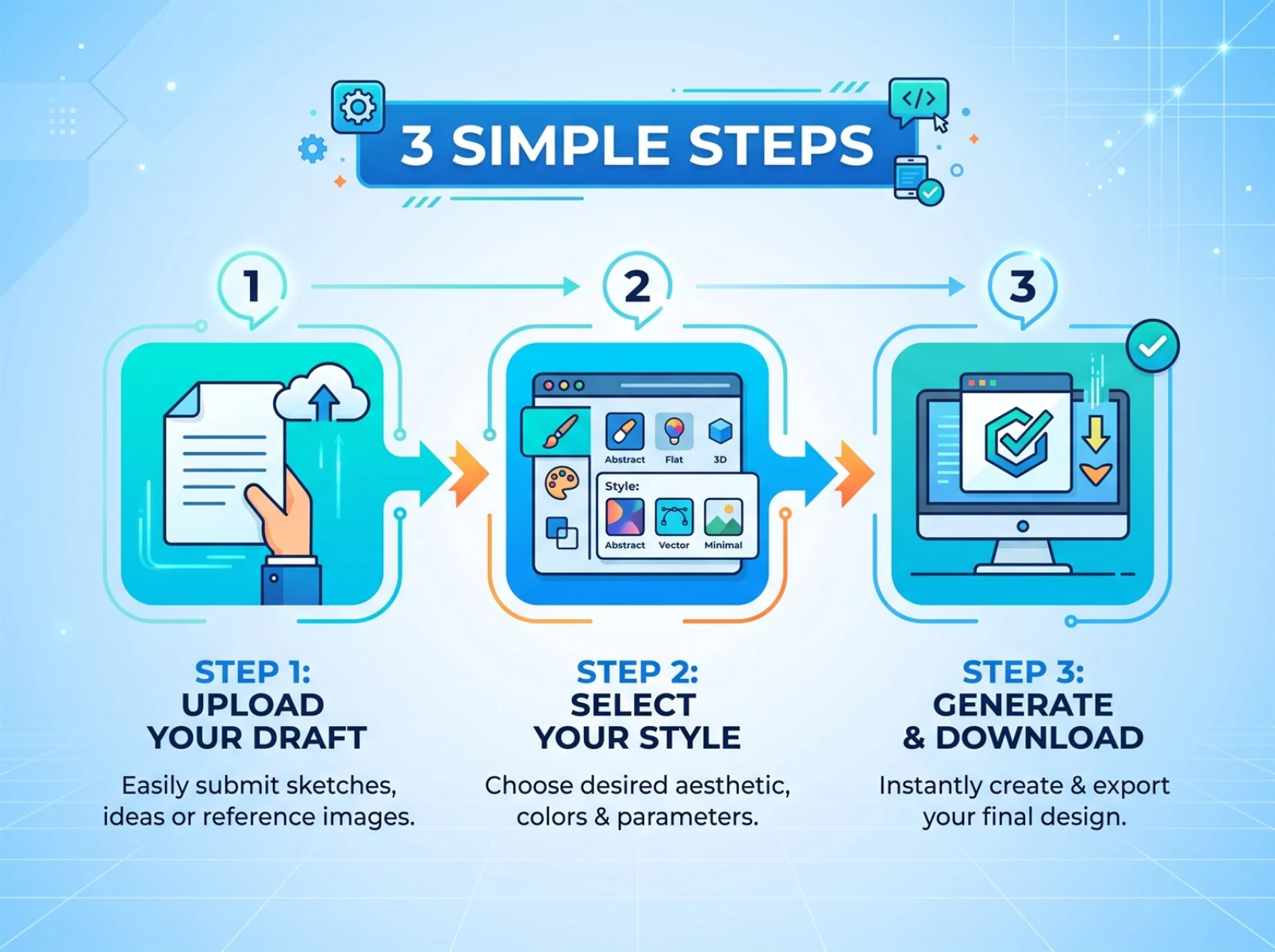
IV. Three Simple Steps: A Sketch-to-Image Tool Accessible Even to Beginners
As a professional sketch-to-image AI tool, Fast Image AI features extremely simple operation with zero learning curve. No expertise in AI parameter tuning is required — just three steps:
Step 1: Upload your sketch. Photos of hand-drawn sketches, tablet line art, even doodles on a napkin can be uploaded directly. There are almost no requirements for line clarity.
Step 2: Set the style and add requirements. Select the corresponding industry style model and add image requests in one sentence — the more detailed your description, the more precise the result.
Step 3: Generate and download. Images are ready in dozens of seconds. If you are not satisfied, you can regenerate, or lock a version for further optimization until you get a commercial-grade final product you are happy with.
This sketch-to-image AI tool requires no download or installation, no high-end equipment, and works entirely online via web browser. You can create images quickly anytime, anywhere, with zero barrier to entry.
V. Redefining Creation: Sketch-to-Image AI Is an Assistant, Not a Replacement
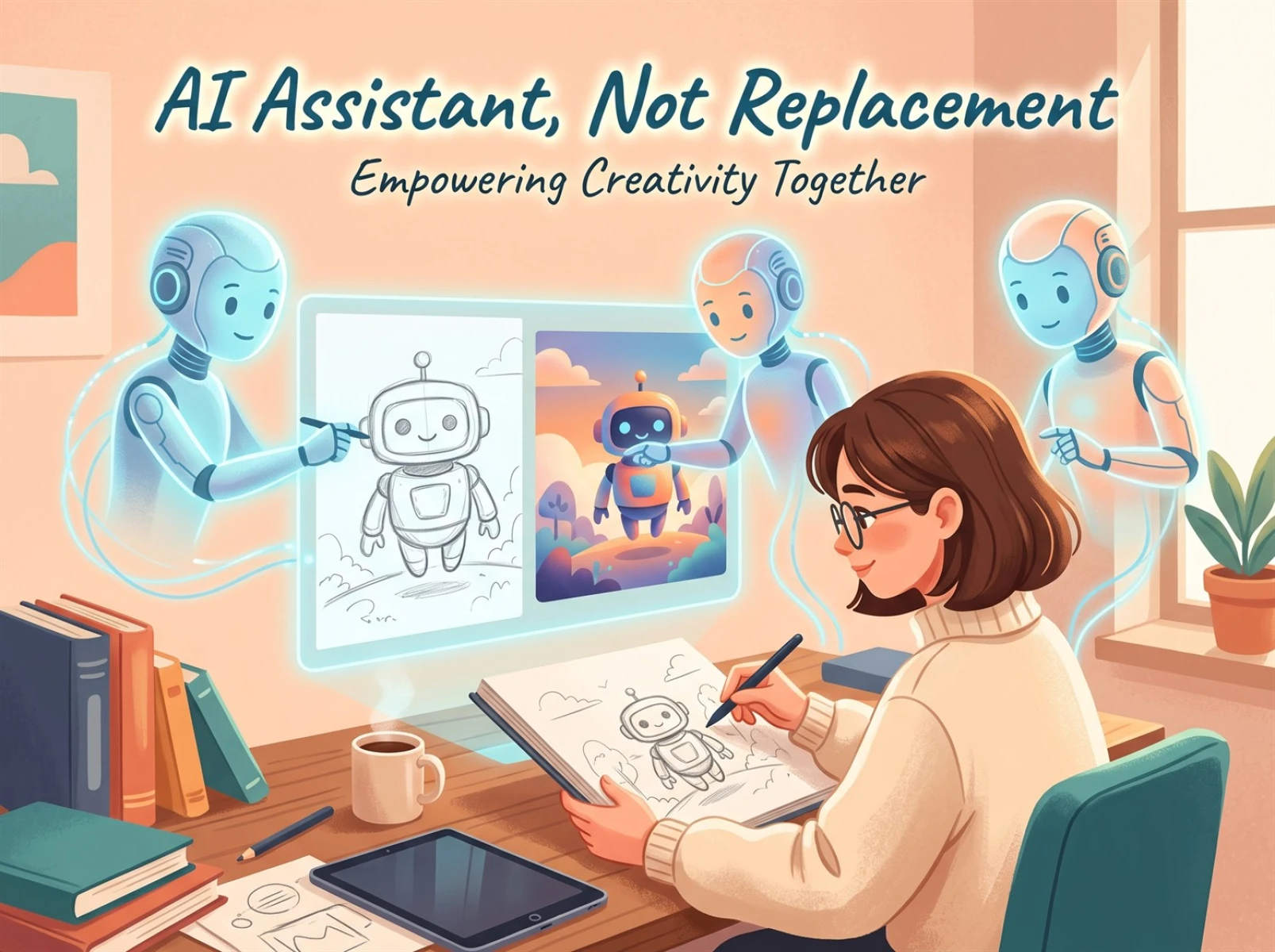
Creators often ask: if AI can turn line art into final images in one click, will it replace designers? The answer is no. The core of creativity will always be human: understanding requirements, exercising aesthetic judgment, shaping narrative — these are abilities algorithms can never replace. But repetitive, time-consuming technical execution work should be handed over to AI. Fast Image AI’s sketch-to-image feature essentially equips every creator with an “AI execution team”: you come up with ideas, draw sketches, and set the direction; the AI handles linework, coloring, rendering, and detailing. Where one person used to produce 3 solutions a week, you can now produce 30; small teams can take on large-scale projects.
It also lowers the barrier to creative expression. Product managers, planners, and entrepreneurs who are not skilled at detailed drawing can also visualize their ideas through sketch-to-commercial-image conversion, eliminating the need for guesswork in cross-role communication. Creativity should not be limited by drawing skills. Let your imagination run wild — let AI handle the rest of the execution.
Conclusion: Creativity That Can Be Executed Quickly Is Truly Valuable
Competition in the creative industry is no longer just about “who has better ideas”. Everyone has good ideas — the difference lies in who can turn ideas into commercial results faster. For the same request, others take a week to deliver a proposal, while you can deliver in one day; others finalize with two solutions, while you can present ten options for comparison. This efficiency gap eventually translates into tangible competitive advantages.
Fast Image AI’s sketch-to-image feature compresses the pipeline from rough sketch to commercial image into dozens of seconds. It unlocks not just a technical step, but the complete closed loop from a flash of inspiration to commercial monetization. For design teams, creative studios, and game and film companies, this is more than just a tool — it is an opportunity to upgrade productivity.
Next time you are facing a tight deadline, rushing a milestone, or validating an idea quickly, you do not have to pull all-nighters to power through. Open Fast Image AI: one sketch, dozens of seconds, and you have a commercial-grade image ready for delivery. Choose the right professional sketch-to-image AI tool, and let your creativity truly outrun time.